Introduction:
Whisky investment has emerged as an exciting alternative investment opportunity in recent years. As traditional markets fluctuate, collectors and investors alike are turning to rare bottles and casks of whisky as a way to diversify their portfolios. Unlike stocks or real estate, whisky offers a tangible asset that combines passion, culture, and potential profit.
Investing in whisky isn’t just about buying expensive bottles. It requires careful research, a strategic approach, and an understanding of the market dynamics. Factors such as authenticity, provenance, storage conditions, and market trends play a crucial role in determining the success of a whisky investment.
This guide will provide a step-by-step checklist for beginners, ensuring you enter the whisky investment world with confidence and avoid common pitfalls. Whether you’re considering investing in a single bottle, a cask, or building a diversified collection, understanding the basics is the first step towards making informed and profitable decisions.
Whisky Investment Checklist
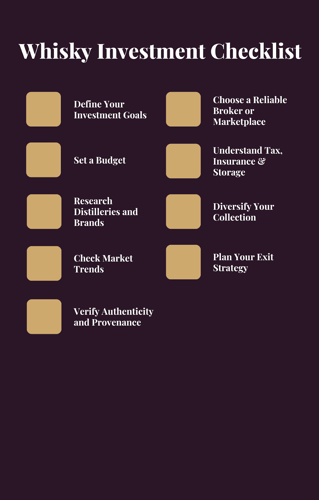
So, how to invest in whisky? Investing in whisky can be exciting, but success requires careful planning and a methodical approach. We encourage you to use this checklist as your step-by-step guide to ensure you make informed decisions and maximise your returns:
-
Define Your Investment Goals:
-
Decide whether your focus is short-term profit or long-term appreciation.
-
Determine if you want to invest in bottles, casks, or a mix of both.
-
Set clear objectives: Are you investing for financial gain, personal enjoyment, or both?
-
Set a Budget
-
Consider the initial capital required for purchasing bottles or casks.
-
Account for ongoing costs: Storage, insurance, shipping, and auction fees.
-
Avoid overextending. Start small and scale your collection as you gain experience.
-
Research Distilleries and Brands
-
Focus on reputable distilleries with a strong track record of appreciation.
-
Limited editions, single malts, and closed distillery releases often outperform standard bottles.
-
Track which whiskies are in high demand among collectors and investors.
-
Check Market Trends
-
Monitor auction results, secondary market pricing, and industry reports.
-
Stay updated on emerging markets like Japanese or American craft whiskies.
-
Look for patterns in price growth, scarcity, and regional popularity.
-
Verify Authenticity and Provenance
-
Always confirm bottles and casks are genuine and properly documented.
-
Ensure proper certificates, labels, and proof of purchase are available.
-
Provenance can significantly influence resale value, especially for rare or collectable whiskies.
-
Choose a Reliable Broker or Marketplace
-
Use accredited brokers, auction houses, or reputable online platforms.
-
Avoid deals that seem too good to be true, as the whisky market can attract fraud.
-
Check reviews, licenses, and past transaction histories of any marketplace or broker.
-
Understand Tax, Insurance & Storage
-
Learn local tax regulations on whisky investment, including capital gains implications.
-
Invest in quality insurance to protect your collection from theft, damage, or fire.
-
Store whisky in controlled conditions to maintain value, casks often require bonded warehouses.
-
Diversify Your Collection
-
Don’t put all your capital into one distillery or type of whisky.
-
Diversify across regions, ages, brands, and limited editions to reduce risk.
-
A balanced collection is more resilient to market fluctuations.
9. Plan Your Exit Strategy
-
Decide in advance how you will sell: Auction houses, private collectors, or specialist brokers.
-
Be realistic about liquidity, rare bottles may take months to sell at peak value.
-
Keep an eye on market conditions to time sales for maximum returns.
Tip: Keep a record of every bottle or cask, including purchase price, acquisition date, provenance, and storage details. A well-documented portfolio not only helps track performance but also boosts credibility when selling to other investors.
This checklist ensures you approach whisky investment with confidence, minimising risks while maximising your potential for profit. By following each step, even beginners can build a collection that combines passion, prestige, and financial reward.
Bottles vs Casks: Which Whisky Investment Is Right for You?
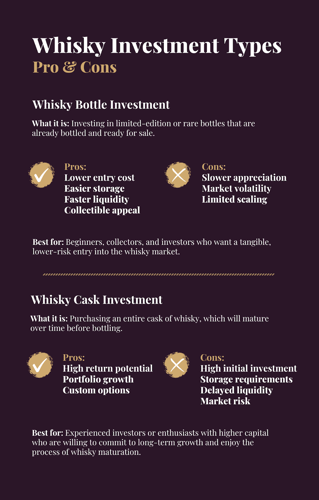
One of the most important decisions is whether to opt for individual whisky bottle investment, or whisky cask investment. Both options offer opportunities, but they differ significantly in cost, risk, and potential returns. Understanding the pros and cons of each can help you make a choice that aligns with your investment goals.
4 Key Factors to Consider When Choosing
-
Budget: Bottles are ideal for smaller budgets, casks for larger investments.
-
Time horizon: In good market conditions, bottles can be flipped more quickly; casks require patience.
-
Risk tolerance: Casks carry higher risk but potential for larger returns; bottles are lower-risk and easier to manage.
-
Interest and involvement: Do you want to be hands-on with maturation and bottling, or prefer collectable bottles that require minimal intervention?
Tip: Many investors combine both approaches: start with bottles to learn the market, then gradually add casks to diversify and increase potential long-term returns. This strategy balances risk, liquidity, and growth.
Common Mistakes New Investors Make
Even with enthusiasm and capital, new whisky investors can fall into avoidable pitfalls. Recognising these common mistakes helps you protect your investment and make smarter decisions:
Mistake 1. Overpaying for Hype
-
Many beginners chase the latest “trending” releases or celebrity-endorsed bottles.
-
Popularity doesn’t always equal value; rare, historically significant bottles often outperform hype-driven releases.
Mistake 2. Poor Storage Practices
-
Whisky is sensitive to light, temperature, and humidity. Improper storage can reduce quality and resale value.
-
Bottles should be kept upright in a dark, cool environment; casks need bonded warehouses with regulated conditions.
Mistake 3. Ignoring Documentation and Provenance
-
Failing to verify authenticity can lead to buying counterfeit bottles or misrepresented casks.
-
Always request certificates, receipts, and provenance records - these are essential for resale.
Mistake 4. Lack of Research
-
Not tracking auction results, market trends, or distillery reputations increases the risk of making bad investments.
-
Relying on guesswork rather than data can result in poor returns.
Mistake 5. Overconcentration
-
Putting all your capital into a single bottle, cask, or distillery increases risk.
-
Diversifying across regions, brands, and bottle types reduces exposure to market fluctuations
3 Tips for Building a Future-Proof Whisky Portfolio
If you’re asking yourself, “Is whisky a good investment?”. The answer is yes, BUT, we strongly recommend that to maximise your returns while minimising risk, it’s crucial to build a strategic, diversified, and sustainable whisky portfolio. Here are our top 3 tips on how to do this:
1. Focus on Rarity and Reputation
-
Invest in whiskies from distilleries with a proven track record of value appreciation.
-
Limited editions, closed distilleries, and unique releases are often more profitable.
2. Diversify Across Types and Regions
-
Mix single malts, blended whiskies, and casks to spread risk.
-
Consider global opportunities, such as Japanese, Irish, and American whiskies, in addition to Scotch.
Tip 3. Prioritise Quality over Quantity
-
A few high-quality, well-researched bottles or casks often outperform a large, indiscriminate collection
Conclusion
Whisky investment combines passion, strategy, and patience. By avoiding common mistakes, following a structured checklist, and building a diversified portfolio, you can turn your love for whisky into a profitable investment.
Starting with research and careful planning ensures that your journey into whisky investment is both enjoyable and financially rewarding.
Ready to take the next step in your whisky investment journey? Contact us